
A tool for this transition

The Time-In ToolKit®
An all-in-one emotional regulation kit. Help your child name what they feel — and model naming what you feel.
- 6 feelings posters
- 35 PeaceMakers affirmation cards
- Activity mat + calming cards
- Digital manual & audiobook
Share
Calming Corner in Preschool Classroom: A Back-to-School Guide for Early Childhood Educators


It is the first week back.
Twelve three-year-olds are learning one another’s names. Some are spending six hours away from a parent for the first time. One child is on the floor because his cubby is the “wrong” color.
Big feelings arrive alongside the backpacks.
A calming corner classroom setup gives those feelings somewhere to land. It is not a punishment spot or a promise that every child will be calm. It is a simple, predictable place where children can practice emotional literacy with a caring adult nearby.
Here is how to create a calming corner in your classroom without a large budget or a Pinterest-perfect setup.
What Is a Calming Corner?

A calming corner is a small, comfortable classroom space where children can notice what they are feeling and practice a calming strategy.
It may include soft seating, a feelings chart, breathing visuals and a few sensory tools. What matters most is the message the space communicates:
Your feelings can be here. The boundary is still here. We can move through this together.
Young children are still developing executive-function and self-regulation skills. According to the Center on the Developing Child at Harvard University, these skills grow through interactions and practice.
This is why emotional literacy comes first.
Asking a child to regulate without teaching them the language of feelings is like asking them to read before they know the alphabet.
Why Are Calming Corners Important in the Classroom?
A calming corner does not regulate a child by itself. The relationship, language and repetition around it give the space meaning.
The U.S. Administration for Children and Families describes co-regulation as an interactive process in which caring adults offer warm relationships, supportive environments and opportunities to practice self-regulation.
In the classroom, that may sound like:
“Your body looks overwhelmed. Would the calming corner help? I can come with you.”
The child is not being removed from the relationship. They are being invited to practice within it.
For infants and young toddlers, regulation remains adult-led. The calming space is somewhere an educator can sit with the child, not somewhere a distressed child is expected to calm alone.
Are calming corners effective?
Early calming corners in classroom research is encouraging, but still limited.
One exploratory study involving first- and sixth-grade classrooms found positive changes across many student self-reports, with students and teachers generally viewing the corners positively. However, the researchers also noted limitations involving the sample, setting and reliance on surveys. The study did not focus on preschool classrooms.
The most accurate takeaway is this:
A calming corner can support emotional-regulation practice when it is paired with connection, instruction and repetition. It is not a stand-alone treatment or a guaranteed way to stop challenging behaviors.
Calming Corner Classroom Setup: Five Simple Steps
Creating a calming corner in the classroom begins with a few intentional choices.
-
Choose a quieter, visible spot. Look for an area away from doors, cubbies and high-traffic centers while keeping the child easy to supervise.
-
Define the space. A small rug, low shelf or floor cushions can show where the calming area begins and ends.
-
Make room for connection. The space can be small, but an educator must be able to sit nearby when a child wants support.
-
Keep it simple. Too many tools can become one more overwhelming choice. Begin with three or four familiar options.
-
Keep it predictable. Use the same location, language and basic routine each day.
What to Put in a Calm Down Corner
A useful calm down corner does not require a large collection of toys. Choose a few tools that help children notice, name and move through what they are feeling.
Feelings tools
-
A feelings chart or feelings cards at the child’s eye level
-
A child-safe mirror for noticing facial expressions
-
One simple book about big feelings
Calming tools
-
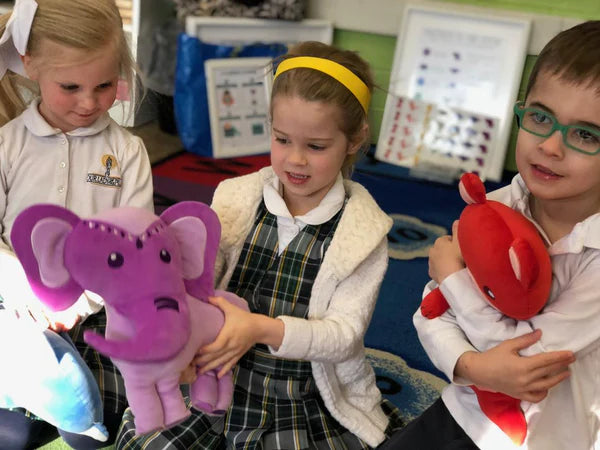
A soft stuffed animal or SnuggleBuddy
-
A squishy or textured sensory item
-
Bubbles, a pinwheel or a visual breathing prompt
-
A drawing pad and crayons
Comfortable seating
-
A small rug
-
A floor cushion
-
A washable blanket
Visual structure
-
A calming corner sign
-
Two or three picture-based calming steps
-
An optional visual timer that is introduced as support, not a countdown or consequence
Not every calming tool works for every child. The useful question is not, “Is this a good tool?”
It is: “What happens in this child’s body when they use it?”
Stay curious, not furious.
The Generation Mindful Time-In Toolkit brings feelings tools, calming visuals and a repeatable process together in one classroom-ready resource.

Calming Corner Ideas and Decor
The most useful calming corner ideas are often the least complicated.
-
Place feelings visuals at toddler or preschool eye level.
-
Choose washable, classroom-safe materials.
-
Use a small canopy or fabric panel only when educators can still supervise the space.
-
Rotate one sensory item at a time instead of filling the corner with choices.
-
Avoid small parts, sharp edges and anything that becomes visually overwhelming.
The MoveMindfully Early Childhood Card Deck also offers movement and mindfulness visuals created for young children. The cards can be used as calming classroom decor or as prompts educators and children practice together.
How to Introduce a Calming Corner to Students
The middle of a hard moment is rarely the best time to explain a new classroom tool.
Introduce the calming corner while everyone feels calm and connected.
-
Show children each item and what it is for.
-
Let every child explore the space during play.
-
Practice one breathing or movement activity together.
-
Use a puppet or classroom story to model a big feeling.
-
Let children see educators use calming strategies, too.
You might say:
“This is a place we can use when feelings get really big. Your feelings can be here, and a teacher can stay close while your body finds calm.”
When a real hard moment arrives, invite rather than threaten:
“Would our calming spot help? I can go with you.”
A child may say no. They may throw the carefully selected tool across the room. That does not mean the calming corner failed.
Keep the boundary. Stay available. Return to the practice when calm comes back.
Its meaning is built through repetition, not one perfect response.
Calming Corner Classroom Rules
Keep the rules brief and visual:
-
Bodies stay safe.
-
Tools stay in the corner.
-
One child uses the space at a time unless an educator joins them.
-
Talking is optional.
-
An educator remains available.
Consistency across classrooms matters, too. When educators use similar words, visuals and routines, children encounter a predictable plan instead of a different response in every room.
Building Calm, One Classroom at a Time
A calming corner will not erase every hard moment of the school year.
It gives those moments a shared plan.
One familiar place.
One practiced tool.
One repeated message:
You are safe to feel. The boundary is still here.
And we can move through this together.
Explore the Time-In Toolkit and MoveMindfully Early Childhood Card Deck, or connect with the Generation Mindful team about supporting multiple classrooms.
Sources
-
Center on the Developing Child at Harvard University. Enhancing and Practicing Executive Function Skills With Children From Infancy to Adolescence.
-
U.S. Administration for Children and Families, Office of Planning, Research, and Evaluation. Co-Regulation in Human Services.
-
Brasfield, M., Elswick, S., Raines, S., Peterson, C. and Mboge, S. Classroom Calming Corners: Peaceful Spaces for Times of Transition. International Journal of the Whole Child, 9(2), 93–111.